Executive Summary
The event, “Greening China’s Financial System”, was co-organised by the International Institute for Sustainable Development (IISD), the UNEP-Inquiry, and China Carbon Forum (CCF).
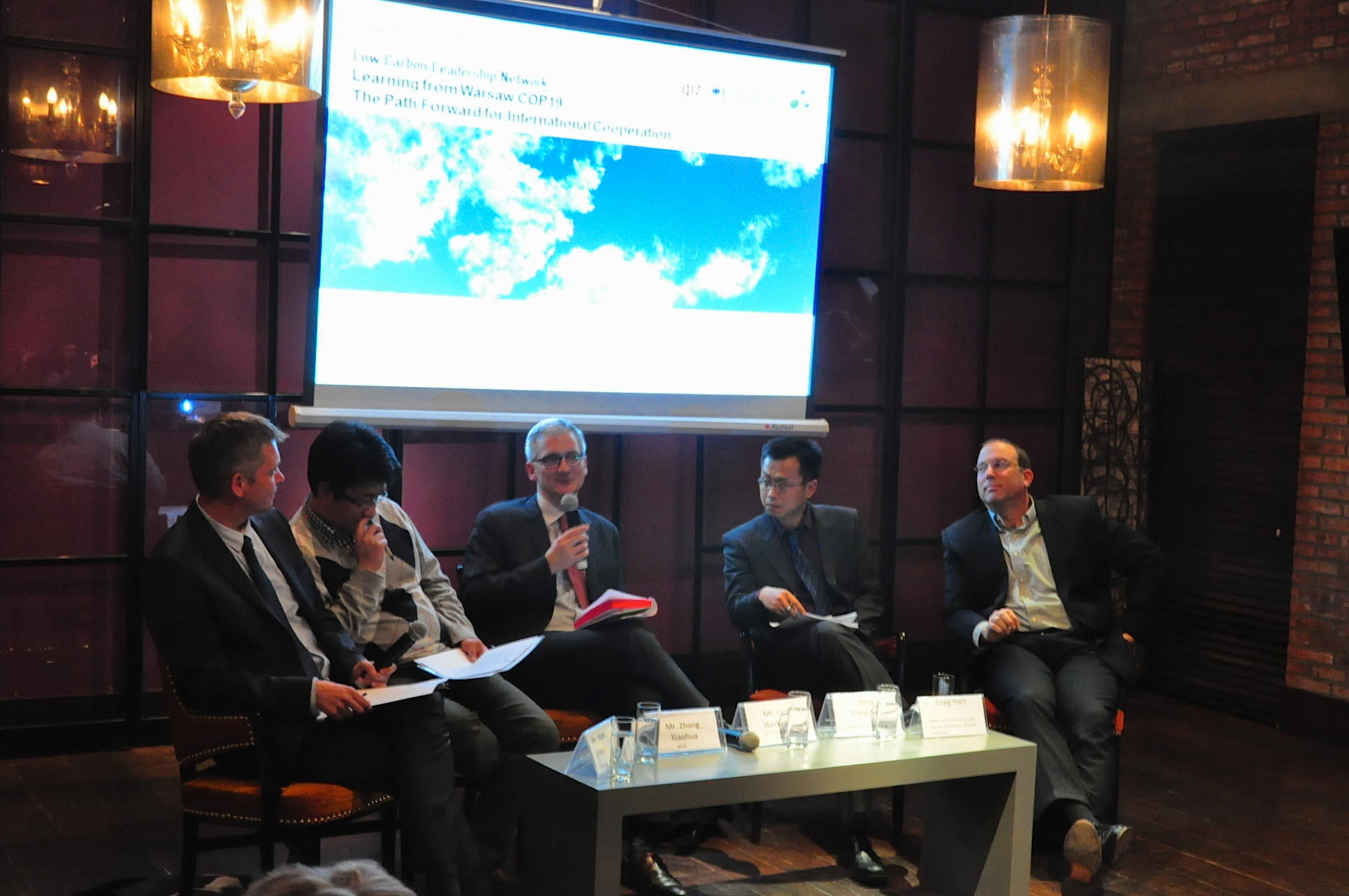
The panel discussion involved a range of eminent speakers who provided comprehensive and in-depth discussion of green finance in China, as well as internationally. The panel in particular discussed the outcomes of two streams of work on green finance. The first, with a new report titled Greening China’s Financial System, is a joint project between the Development Research Centre of China’s State Council (DRC) and IISD. The second is from a joint Green Finance Task Force co-convened by the People’s Bank of China (PBOC) and UNEP-Inquiry.
The speakers on the panel discussions presented a good balance of perspectives, approaching the topic from governmental, academic and think-tank viewpoints. This range of views made for a stimulating Q&A session with the audience. Many stayed on afterward to network and discuss the topic of the morning, providing a valuable forum for interaction and networking between counterparts, especially business, NGOs, foundations, policy experts and government representatives.
Record of Discussion
The following is an edited synthesis of discussion that took place at the event among panellists and open Q&A with participants. As per convention, individual’s comments are not attributed.
The panel discussed the progress of important research on green finance in China, and launched the Synthesis Report on Greening China’s Financial System, a joint project between the Development Research Centre (DRC) of the State Council and IISD. The report represents a significant milestone after 18 months of work by the partner organisations, and was launched at the China Development Forum in March 2015. The discussion also covered a separate stream of work involving the People’s Bank of China and UNEP-Inquiry on developing a sustainable financial system for China.
The panel provided some background to the discussion of green finance. Global financial assets, more or less, amount to USD 305 trillion. That is up from USD 115 trillion in 2002. However, this is in the context of other forms of capital, especially natural capital, being rapidly depleted.
China is an important stakeholder when it comes to finding effective ways to encourage green finance, because China faces extensive environmental challenges while it is already one of the largest investors in clean technology. Almost $90bn. was invested last year (a 32% increas) in such technologies, much larger than the next largetst investor, the US, at $51bn.
Existing efforts in China include the Green Credit Guidelines, produced by the China Banking Regulatory Commission, which aim to encourage innovative ways of greening development finance across the country. The two projects being discussed today, involving the State Council DRC and the People’s Bank of China, involve different approaches, but are closely coordinated through partnership with UNEP-Inquiry and IISD. It is important to note other complementary work is also taking place, in particular the China Council for International Cooperation on Environment and Development (CCICED) also has a taksforce looking at green finance.
This research is released in the context of international momentum on green finance. The panel noted that this year will see the Finance for Development Summit in Addis Ababa in July and the UN summit on Sustainable Development Goals for the post-2015 development agenda in New York in September. Finally, the UNFCCC Conference of Parties will take place in Paris in December, hopefully building on progress made during the year.
A few years ago green finance led to a concentration on providing options to those actively interested in “being green”. Now there is a realisation that the way that the finance system works will determine whether or not a sustainabile economy is achieved. The chrystalization of all the aspects that need to come together is happening in China, perhaps faster than anywhere else. This is due to: 1) China’s process of economic reform which make new approaches possible where they weren’t before, and 2) a strong message from the leadership that the transition to an “eco-civilisation” is an absolute priority for China’s development. This combination provides a “perfect moment” to progress green finance in China.
State Council Development Research Centre (DRC) and IISD project
The Greening China’s Financial System is the product of two years work, between the State Council DRC and IISD. The key points include:
China has moved early on green finance, although the financial system is not yet sufficiently competitive. The PBOC has had policies relating to green finance since the 1990s, limiting lending to polluting and energy-intensive industries. Later, by 2007, the CBRC put forward guidelines for green lending. Several years later, the CBRC announced that it would release guidelines on green credit ratings. China’s Environmental Pollution Liability Insurance system (EPLI) was also relatively early on the scene, and this is subject to ongoing improvement. While these efforts are not yet mature, they are on the table and markets are preparing to react.
The financial market is still underdeveloped and the institutions do not have the capacity to lead on green finance. Because the financial system is underdeveloped, however, this also offers flexibility in how it develops from here. China’s experience and practice is valuable for learning internationally about green finance, and both its successful experiences and pitfalls can and should be observed by other countries.
However you look at green finance internationally, however, it is clear that we are still far from an ideal green financial regime, and far from the volumes required to meet the demand for green investment. Research by the PBOC suggested that in the period 2015-2022 at least RMB 3 tln would be required for green investment in China, RMB 2 tln of which would need to come from the financial system. Only 7% of current financing in China currently could be described as “green”. Given that provision of finance reached about RMB 10 tln last year, even 10% of this would not be enough to meet demand for green investment in coming years. In addition, Chinese banks have been reluctant to sign up to the Equator Principle, as it would impose significant constraints on their operations, possibly compromising their competitiveness and market share.
The reasons for the current situation include:
- The legal system is still lagging behind. Legislation does not impose strict enough penalties, including newly released regulations. Enforcement is also ineffective.
- The cost and pricing of environment impact is still problematic. The negative cost of pollution and emissions is not factored in to economic statistics.
- There is lack of definition for financing policies, esp. for green bonds.
- There needs to be much better communication between key stakeholders, including financial institutions, oversight bodies and environment agencies.
- There is not sufficient policies to support the development of third parties. Green finance is where industry and the environment meet. This means that there are technical issues which are outside industry’s existing expertise. Policy should support third parties to fill this gap.
- Finally, there is a lack of awareness of green finance amongst society at large, including amongst attendees of the China Development Forum, which represents a concern.
The PBOC/UNEP Green Finance Taskforce
The Green Finance Taskforce, co-convened by the PBOC and UNEP-Inquiry has brought together leading Chinese financial policy and regulation experts and international experts to mobilize knowledge, assess options and make specific proposals for establishment of a comprehensive green finance system and the promotion of green investment. The taskforce has also consulted extensively with the private sector in order to produce meaningful outcomes, the results of which will be released in a report in April. Although the report is not yet finalised, the panel discussed the main themes at the workshop.
China’s air, water and soil pollution challenges all require significant green finance. Therefore, we need to change the direction of investment. In the future, investments need to go towards cleaner and greener industries. If the direction of investment changes, the allocation of technology, human resources and production will also switch towards greener industries. The finance sector is important for facilitating this switching of investment towards greener industry. Historically, the public sector has only been able to provide about 20% of the finance needed, with 80% coming from the private sector. It is clear that much will be required of the private sector during this transtion, and incentives need to be provided to attract private finance to green industries.
The panel described several key advantages of green finance. Green finance is an important policy option to help achieve the goal of stable economic growth and development and adjustment of the economic structure. Green finance can help to exploit new areas of potential economic growth. At the same time it can accelerate innovation in the industrial structure, energy structure and transportation structure. Green finance can also help ease constraints on government finance when facing environment problems. Government funds can leverage more than 10 times the amount of investment from the private sector, for example through green banks, green bonds and tax exemptions.
The research work sought to create a framework for effective green finance, which includes:
- Increased rates of return on green investment. This addresses the existing problem of investors not being satisfied with the expected ROI for green projects. We need to find low-cost means of financing projects and making them more attractive to investors.
- Raise the cost of pollution/emissions. This “strikes at the heart” of our transport and energy mix. Bringing down the relative cost of greening these sectors can create a huge shift in their impact.
- Incentives for customers and producers. Build on the leadership of large corporations that use CSR as a market opportunity and help expand consumers’ green consumption consciousness.
Key recommendations of the taskforce:
- Institution building. Establish new, professional institutions that are engaged in green credit and green investment, including a green banking system and green investment funds. The PBOC has specifically looked at the UK example of a green investment bank, which plays an important role in making projects viable. It is also important to encourage a green securities market, or equity. It is hoped that local government will participate in the development of these institutions.
- Reduce the cost for green financing. Fiscal policies can be designed to improve the leverage effect, by realising thirty more dollars for every public dollar spent. The new institutions outlined above should support the “ecosystem” of green investment and manage these subsidies and incentives. Transparency and oversight is required. KfW in Germany provides a good example in this regard. In addition, there is a maturity mismatch for loans to many green projects. There is room to allow banks to issue longer maturity loans. Other measures could include waiving the corporate tax liable for profits on green bond sales. Also, from a regulatory angle, offering preferential treatment of green bonds on a bank’s balance sheet. This could reduce risk for banks issuing green bonds.
- Foster the development of infrastructure for the green financial system, including a green stock index. This should be driven not just by government, but also the private sector, especially securities exchanges. Most mainstream exchanges do not currently have a focus on green assets. In fact many listed companies, and a high proportion of the stock market value, are invested in “dirty assets”. So investors have no choice but to put resources with these older industries. A green index will give investors a green option, complemented a green rating system. A green investment network would also be useful, as exists abroad in some places. These can control large amounts of investment in a kind of syndicate.
- Establish and strengthen legal frameworks. Environmental liability for banks lending to polluting projects means that victims can sue the banks. Examples exist in other developing countries. Compulsory green insurance is also important, given the wide occurrence of bankruptcy of polluting companies. This puts the potential environmental costs on the books for companies. Finally, compulsory disclosure requirements for environmental impacts allows companies’ performance to be assessed.
International experience
The panel commented on the need to build consensus in the international community, of the importantance of green finance. Countries such as the UK, France, China and Indonesia have been taking the lead on the issue, but the enthusiasm is not shared with all countries. Some countries‘ needs may vary but especially in developing countries, fiscal resources will not be sufficient. In addition, there can be differences in definitions of green finance, as developed countries tend to emphasise greenhouse gas emissions, whereas developing countries emphasise localised pollution. In addition, there is a difference in paths, where developed countries prefer to frame the issue in terms of investor social responsibility. This leads to green securities growing very quickly but green lending growing more slowly. Developing countries on the other hand are more likely to utilise public investment. While it is difficult for all parties to agree on the same path, we can allow for diversity in terms of methodology while working to coordinate efforts. Green credit ratings and regulatory risk assessment is an area where common standards could be developed between countries.
Existing forums have begun to discuss the importance of green finace, for example the Silk Road Fund, the AIIB and the forthcoming BRIC bank. In addition, the panel suggested that environmental performance has become a much bigger issue for Chinese companies today. China’s larger companies are now operating in many countries and that brings reputational risk. It is also, therefore, an important issue for the Chinese government. The panel suggested that China should aim to meet the environmental standards of the IMF and World Bank in its investments, and in the future to do even better (by going beyond existing standards or making new standards/rules). The better the standards for Chinese companies at home, the more likely they are to lift their standard overseas.
The panel emphasised that the strength of developing green finance, as opposed to emphasising regulatory measures in relation to pollution, is that it directs resources to new areas of growth. It can both suppress investment in polluting industries, while encouraging investment in cleaner industries. This shift in resource allocation is more efficient that regulatory measures, and less costly overall.
The UNEP-Inquiry programme has found that much is going on internationally in green finance, including central banks, financial regulators, policy makers and setters of standards for financial and capital markets that are beginning to think differently on the subject and experimenting. The Sustainable Stock Exchanges Initiative is an important complementary measure to these efforts.
Singapore stock exchange provides a good example, where listed companies are not just required to report on sustainability but there is a system of fines to ensure a high quality of reporting. Credit rating agencies are also starting to actively engage with sustainability, with S&P creating a methodology for assessing climate risk across all of its ratings. South Africa has introduced a requirement that trustees report on environmental issues in relation to its well-developed institutional investment sector.
The panel also commented on the role of central banks, and in partciular that the Bank of England has introduced a prudential review of climate risk on the stability of the insurance sector in the UK. This may exapand to the banking sector. As the banking sector becomes more aware of the issue of climate risk, China may consider undertaking a similar prudential overview of its insurance and banking sectors. Kenya’s central bank has also facilitated the highest level of penetration of mobile banking which has increased the level of financial inclusion over a remarkably short period of time to a high level.
Indonesia has launched it’s Roadmap for Sustainable Finance which brings green issues in to the heart of how capital markets work in the country. The effort will evolve over time, but it marks the first time that capital requirements for banks have been examined as to whether adjustments should be made on account of environmental considerations.
There is also consideration now as to whether the balance sheets of central banks could be utilised more effectively to channel finance in ways which facilitate the green transition. Bangladesh has begun using its balance sheet refinancian operation to support banks that are investing in green and rural economy assets.
Overall, these international efforts represent a blossoming of ambition and experimentation in green finance, and reflects increasing willingness of key stakeholders including policymakers,. central banks, regulators, standard setters, credit ratings agencies and accounting bodies, to try and bring the environment in to alignment with the underlying design of the financial system.
The downside is that the efforts are still fragmented and we are still unclear about the benefits and costs of various approaches. The challenges are not yet dealt with in a comprehensive way that allows for policy to chart a clear course. The panel described the challenge as: “we see all the stars in the heaven, but we don’t understand how the heaven works”. China, of all countries, is taking positive steps to addressing these challenges, including the work of the PBOC, DRC and CCICED (under MEP). This work is helping to provide a framework for understanding how the stars fit together and relate to one another.
The panel commented that multilateral organisations have proved to be slow to react to innovations in green finance, and rather the “stewards of convention”. This has been the case even when it can be shown that new approaches are beneficial. This will gradually change and resistance will be overcome, leading to the organisations actively contributing to the process. This is laregely up to the member nations of those organisations to push forward on green finance.
The final report of the UNEP-Inquiry will draw together the lessons learned from countries around the world. It will be launched at the IMF/World Bank meetings in October 2015 in Peru. It intends to engage widely with partners in order that the lessons are carried forward as much as possible.
Observations on China
The panel commented on the likelihood of green finance being a topic covered within the 13th Five Year Plan, as well as the 19th Party Congress language. If this happens, China would become the first country to place green finance in its highest level of strategic policy directives. This would also represent incredible progress for China which has arrived at this point much quicker than developed countries with far more mature financial sectors.
While those working on green finance focus heavily on the issue, it is important to keep in mind where the issue fits in relation to China’s other priorities. China is not lacking for important issues on its policy agenda. The finance sector faces significant challenges in relation to the welfare system, established industries, as well as new areas such as e-finance. For those concerned about sustainability, it is important to make sure that green finance is raised in the most important policy initiatives, at the very least alongside these other key areas.
China’s “one belt, one road” strategy also provides an opportunity to push green finance internationally. China can work with its trading partners to find ways to promote green finance, alongside the trading initiatives. The panel also suggested that China should work to have green finance included in the decisions and communiques of multilateral meetings such as the G20.
The panel emphasised the need to continue to prove to stakeholders the importance of prioritising green finace. The changes needed won’t happen by themselves. At the same time, change in China will work best if the international community aims to “encourage” China, rather than “teach” China. While this seems to be happening so far in the area of green finance, the nature of engagement in relation to expectations for reform from the international community is a key issue for China.